Hours of service (HOS): The Basics
Last updated 4 months ago
Commercial truck drivers in the United States operate under federal rules that control how many hours they can drive and work in a single day and across a rolling week. These rules — known as hours of service (HOS) — are enforced by the Federal Motor Carrier Safety Administration (FMCSA) under 49 CFR Part 395.
The reason these limits exist is simple: a fatigued driver is a dangerous driver. HOS rules set mandatory rest periods to ensure drivers are rested before getting back behind the wheel.
Most drivers subject to HOS rules are required by the ELD mandate to record their duty time using a certified electronic logging device (ELD). An ELD connects to the vehicle's engine and automatically captures driving activity, replacing paper logbooks. Paper logs are still permitted in a small number of exempted situations.
Understanding these rules matters for everyone on your team — drivers avoid violations and out-of-service orders, fleet managers protect their safety rating, and carriers stay in good standing with shippers and enforcement.
Which drivers must follow HOS rules?
HOS rules apply to drivers and carriers operating CMVs in interstate commerce. Your vehicle is a CMV if it meets any one of the following (49 CFR § 390.5):
Weighs 10,001 lbs or more (GVWR or GCWR)
Carries 9 or more passengers for compensation
Carries 16 or more passengers without compensation
Transports hazardous materials requiring a placard
Note
If you drive entirely within one state, different state-level rules may apply. States can be more lenient than the federal standard for intrastate commerce.
How daily driving limits work?
Three clocks run simultaneously during your shift: a driving clock, a shift clock, and a weekly clock. Understanding all three is essential — a violation occurs the moment any one of them is exceeded.
The 11-hour driving limit
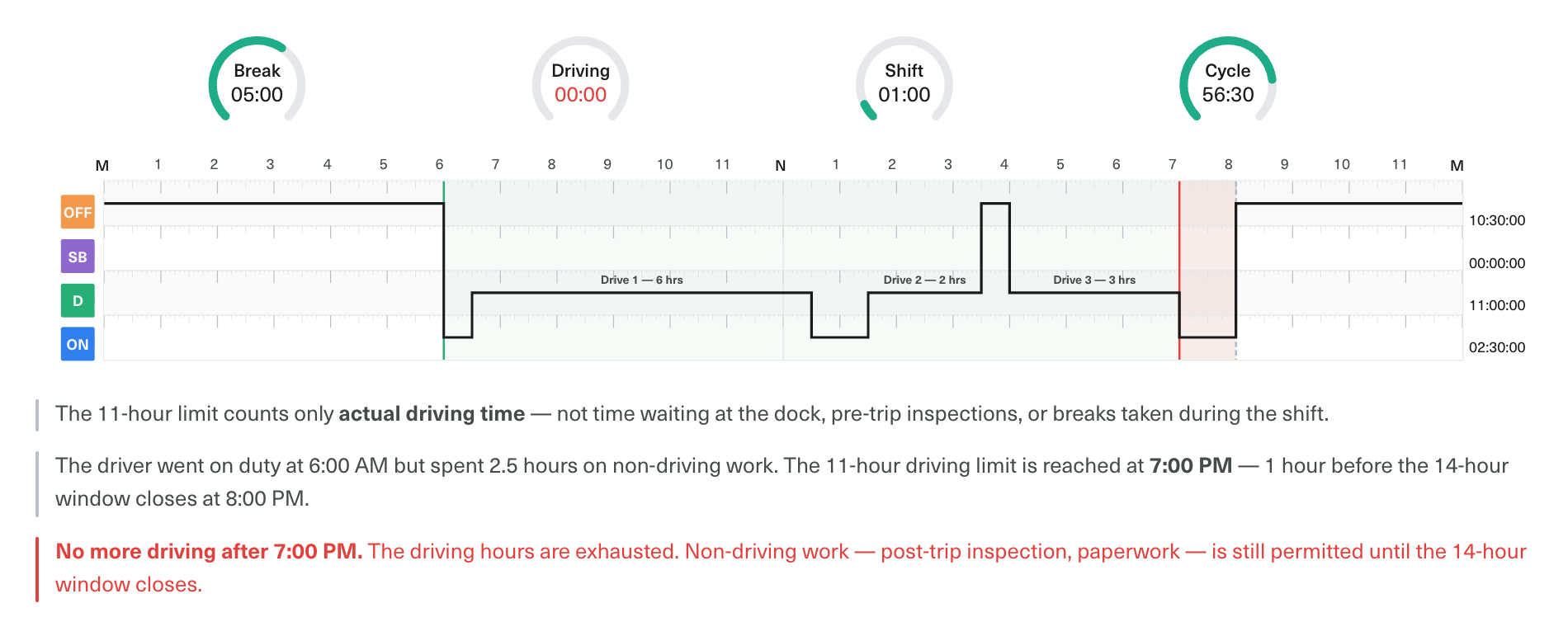
You may drive a maximum of 11 hours in a 14-hour shift, but only after taking at least 10 consecutive hours off duty to start (49 CFR § 395.3(a)(3)(i)).
The 14-hour on-duty window
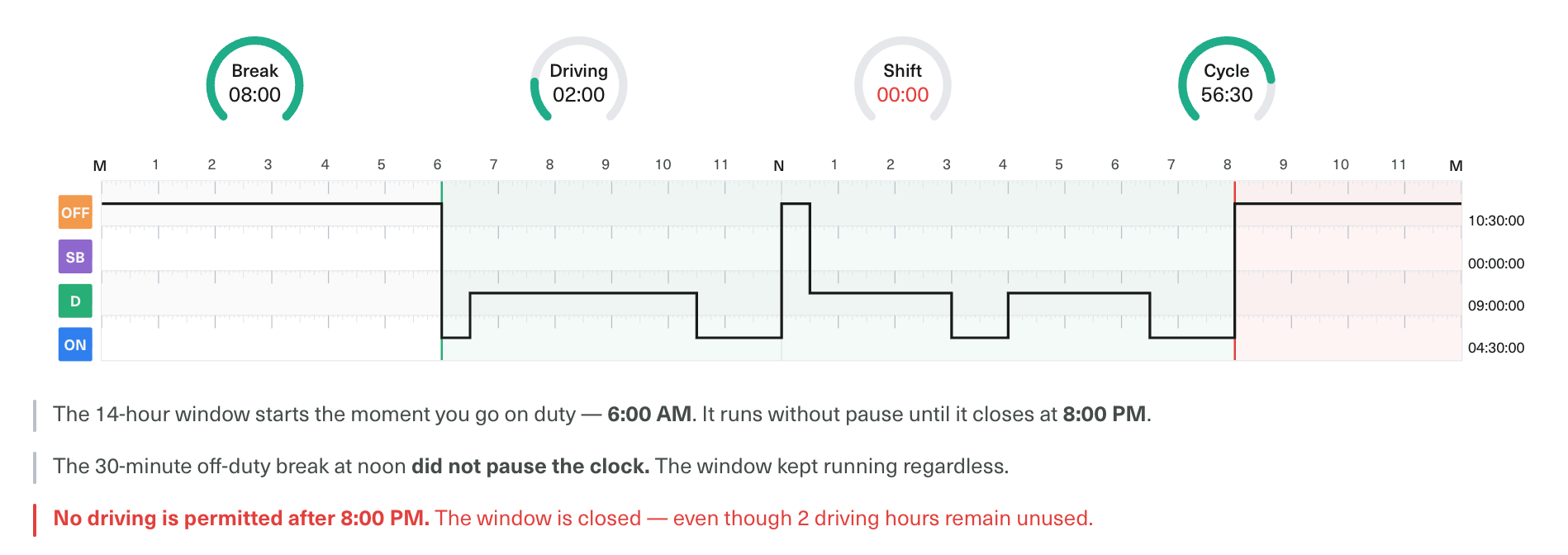
Think of the 14-hour window as a running clock. It starts the moment you go on duty and counts down for exactly 14 working hours — whether you are driving, doing paperwork, eating, or waiting at a dock. When it reaches zero, you cannot drive again until you have taken at least 10 consecutive hours off duty (49 CFR § 395.3(a)(2)).
Within that window, you may drive up to 11 hours. You do not have to use all 11 — but any driving must happen before the window closes.
The 30-minute break
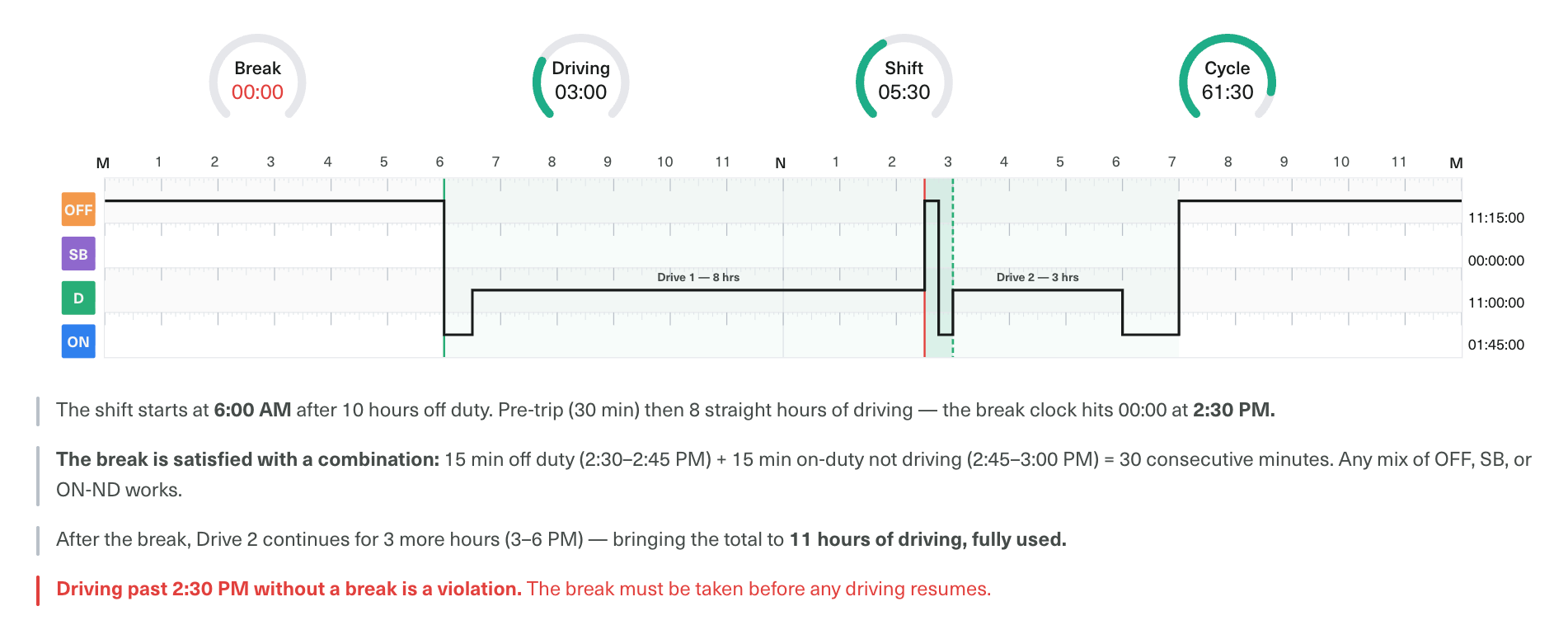
After 8 cumulative hours of driving, you must take at least 30 consecutive minutes off driving before you can drive again. The break can be logged as off duty, sleeper berth, or on-duty not driving (49 CFR § 395.3(a)(3)(ii)).
Note
The 8 hours is cumulative driving time — not time since your shift started. You could drive 4 hours, do 2 hours of on-duty work, then drive another 4 hours before the break requirement triggers.
The 60/70-hour weekly limit
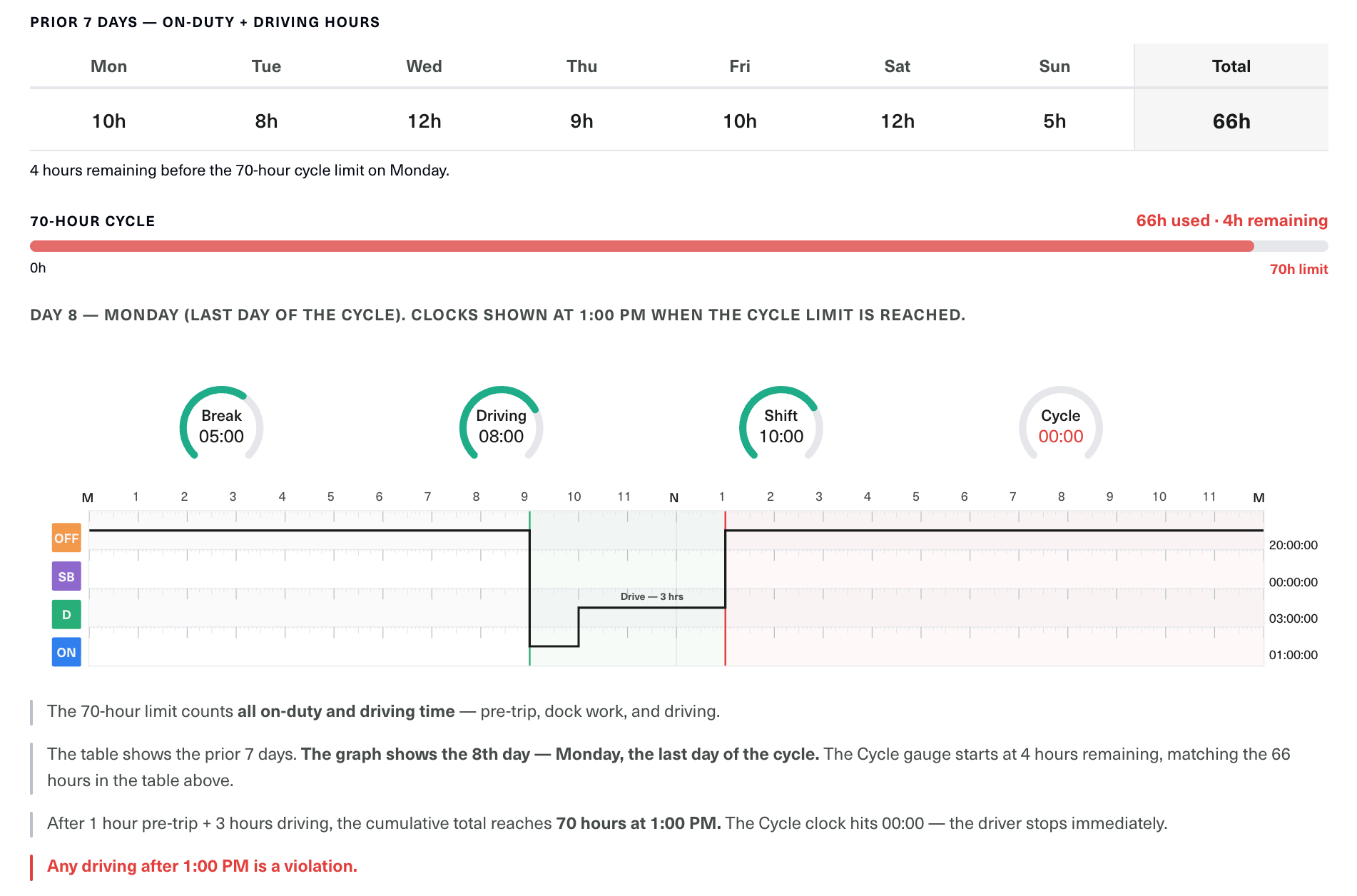
Regardless of your daily hours, you cannot drive once your total on-duty time across the rolling week reaches your carrier's limit (49 CFR § 395.3(b)):
Your carrier's schedule determines which limit applies — not your own driving schedule. The cycle rolls forward daily, dropping the oldest day and adding the new one.
Example of 70-hour / 8-day cycle limit
The 34-hour restart
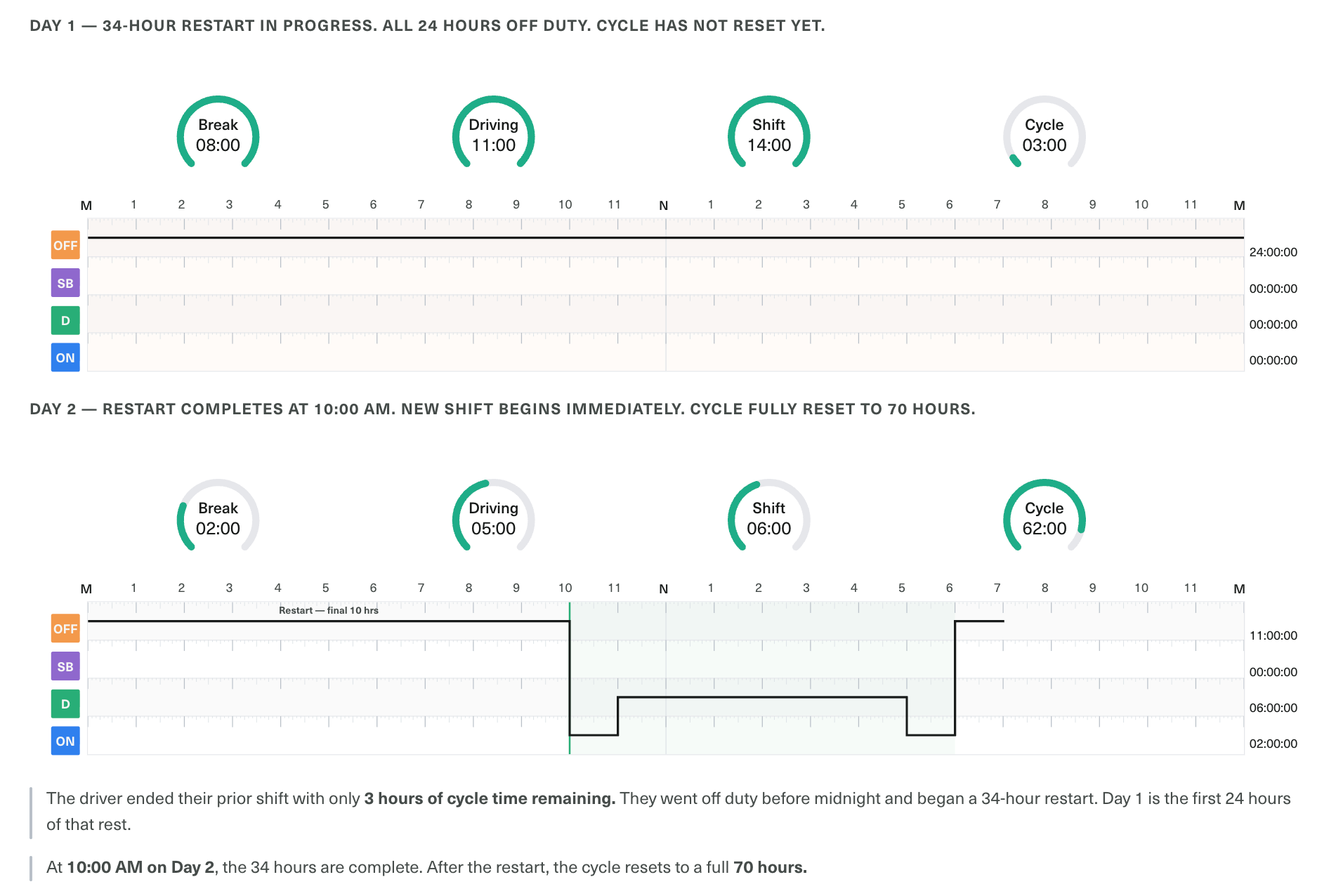
Once you hit your weekly limit, you can reset it to zero by taking at least 34 consecutive hours off duty (49 CFR § 395.3(c)).
Sleeper berth provision
If your truck has a sleeper berth, you can split your required 10 hours of off-duty rest into two separate periods instead of taking them all at once. This gives long-haul drivers more flexibility when planning rest around traffic and delivery windows (49 CFR § 395.1(g)).
Requirements for a valid split:
Neither period can be shorter than 2 consecutive hours
One period must be at least 7 consecutive hours spent in the sleeper berth
Both periods combined must total at least 10 hours
The two most common configurations are:
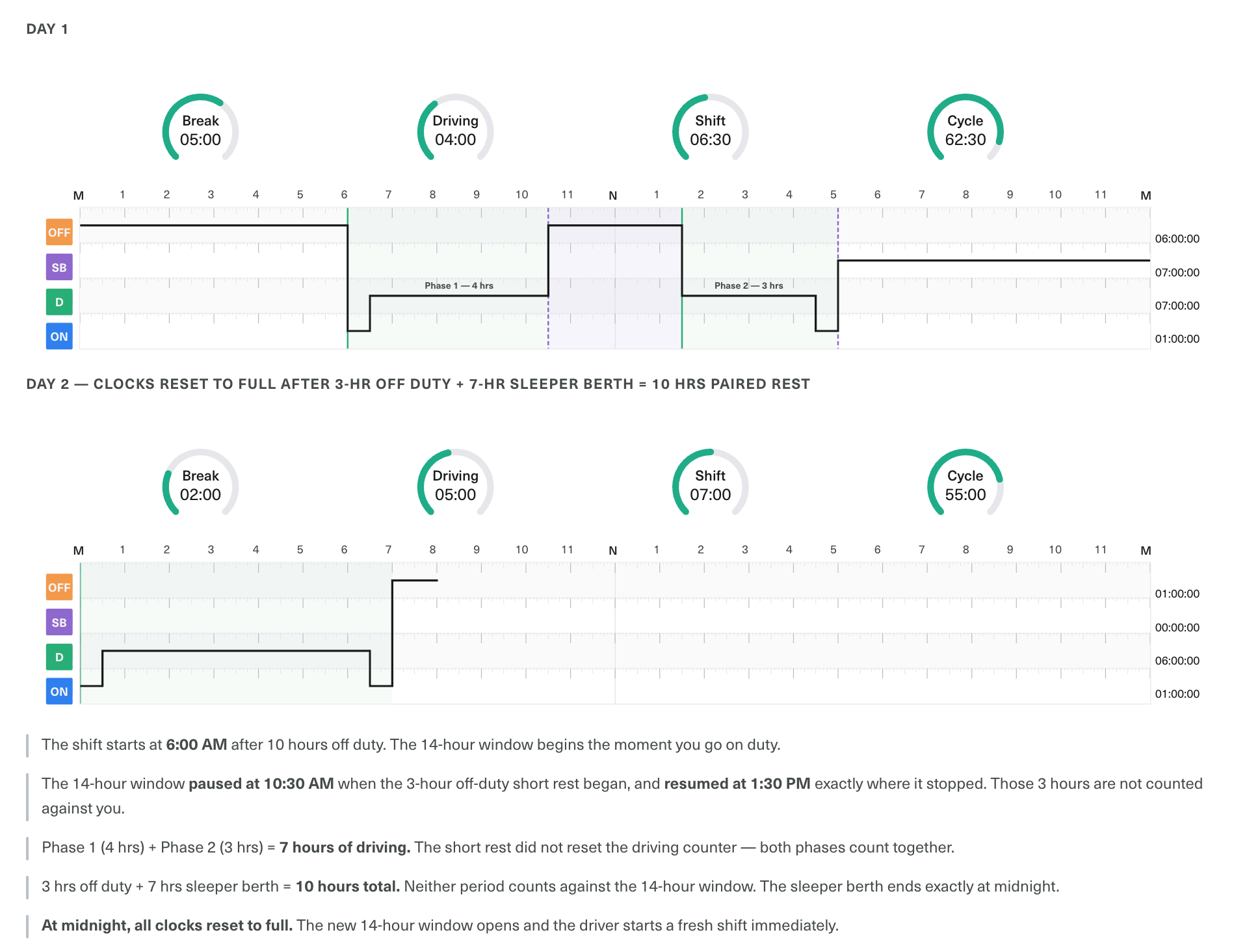
7/3 split — 7 consecutive hours in the sleeper berth, plus at least 3 hours off duty or in the sleeper berth
8/2 split — 8 consecutive hours in the sleeper berth, plus at least 2 hours off duty or in the sleeper berth
The 14-hour window pauses during the shorter rest period and resumes from where it left off. Driving hours accumulated on both sides of the split count together against your 11-hour limit.
Example of 7/3 split rule
Note
The sleeper berth provision is only available on vehicles equipped with a sleeper berth that meets the specifications in 49 CFR § 393.76. Standard cab trucks do not qualify.
Which HOS exemptions apply to you?
Several exemptions change or remove HOS requirements for specific types of operations. Using an exemption you do not qualify for — even if your logged hours look fine — can still result in a violation.
Short-haul exemption — CDL drivers
CDL drivers who stay close to their home terminal and return each day may be exempt from the ELD requirement and daily log (49 CFR § 395.1(e)(1)).
You qualify if all of the following apply:
You operate within 150 air miles (172.6 statute miles) of your normal work location
You return and are released from duty within 14 consecutive hours
You take at least 10 consecutive hours off before your next shift
The 11-hour driving limit and 14-hour window still apply. Only the ELD and daily log requirements are removed.
Note
Even without a daily log, your carrier must keep time records for 6 months showing your start time, total on-duty hours, and release time each day.
Short-haul exception — non-CDL drivers
Non-CDL drivers who operate within 150 air miles and meet the same return conditions can extend their on-duty window from 14 to 16 hours up to two days per week (49 CFR § 395.1(e)(2)). The 11-hour driving limit does not change.
To remain eligible, you must use the standard 14-hour window for at least 5 of every 7 consecutive days.
Adverse driving conditions exemption
If you encounter unexpected severe weather or road conditions after your trip has already started, you may drive up to 2 additional hours (49 CFR § 395.1(h)(1)):
Driving limit extends from 11 to 13 hours
On-duty window extends from 14 to 16 hours
Qualifying conditions (49 CFR § 395.2): sudden snow, ice, fog, or road closures that were not foreseeable before you left or before your last qualifying rest period.
Warning
A forecasted storm, rush-hour congestion, and loading dock delays do not qualify. Conditions must be genuinely unexpected after your trip started. This extension does not increase your 60/70-hour weekly limit.
How to document your HOS compliance?
Most CMV drivers must use a certified ELD to record duty status automatically. At a roadside inspection, you must display logs for the current day and the previous 7 days. Route One ELD makes this available in DOT Inspection Mode directly from the driver app — no printing required.
Your carrier must retain your logs for at least 6 months (49 CFR § 395.8(k)).
Note
Short-haul drivers who qualify under 49 CFR § 395.1(e), and drivers operating vehicles built before model year 2000, may use paper logs instead of an ELD.
If you haven't set up your ELD yet, visit the Get Started collection first.